
How to Learn an Accent
A basic beginner's guide

(This blog post takes very heavily from the books How to Do Accents, by Edda Sharpe and Jan Haydn Rowles, and Foreign Dialects, by Lewis Herman and Marguerite Shalett Herman - a lot of it is rephrasing sections of the books in short and in more formal linguistics language. Some sentences are at least nearly word-for-word copied - stuff like instructions on where to move the tongue to pronounce certain forms of certain consonants. The main body of the post, especially the part of the Sound Correspondences section that isn’t about the IPA, is based on How to Do Accents, and Appendix 2 is based on a chapter in Foreign Dialects.)
Let’s say you want to learn another accent. Maybe you need it for a play, or you want to pretend to be an exchange student, or you’re just doing it for fun. It’s possible to do a lot of accents passably just by picking them up from the culture – French, German, Russian and so on – but maybe you want to learn the accent in more detail, on a finer level.
You may have heard that this is only possible for children, and the ear loses the ability to pick up accents later. This isn’t true. Watch this video:
The actress there, Amy Walker, learned most of the accents as an adult, and nowadays she’s better at them than she was when she made the video. Children can pick up accents more easily, but adults can still learn with work.
The three ingredients for learning an accent are
1) Listening
2) Sound correspondences.
3) Practice
In brief, one should listen to people speaking the accent a lot, learn which sounds in one’s own accent map onto the accent one is learning, and practice the accent as much as one can.
1 – Listening
The first step is to know what the accent sounds like. For a quick overview, YouTube has “accent tag” videos where people read certain words in their accent (some interesting examples). For a deeper look, find audio where people speak without thinking about what they sound like. Cut the audio into small chunks, put silence between the chunks, and imitate the accent during the silence. Eventually, try to imitate the accent while the person is speaking – see how close you are. Try to nail down the melody of the accent and the stress pattern – which syllables are stressed, or if any are at all.
For close analysis of how certain sounds are pronounced, use a Kit List. A Kit List is a list of sets of words where all the words in each set use the same vowel, meaning that by listening to how an accent pronounces one of the words in each set, one can tell how the accent pronounces the same vowel sound in a lot of other words. For example, “kit” and “fit” are pronounced with the same vowel, so one can take the pronunciation of “kit” to find how to pronounce “fit”.
You will also have to learn the melody of the accent – how the pitch of a normal sentence goes up and down, how to emphasize or ask a question. As Amy Walker points out, even being slightly off-pitch can make an accent unconvincing.
As you learn about various accent features, such as rhotic vs. non-rhotic and dark l vs light l, listen for these features specifically.
2 – Sound Correspondences
An accent is broadly about taking certain sounds and substituting certain other ones, so it’s useful to know exactly what sounds to swap out for what. Of course, it’s hard to pin down specifically what sounds one’s saying or hearing, especially when English spelling is so disconnected from pronunciation (there are at least 7 different ways to pronounce “ou” – think of “soul” and “famous”.) It feels like to communicate specific sounds in writing without constantly writing things like “the ‘ou’ in ‘soul’”, one would need another alphabet.
Fortunately, there’s an alphabet for that exact purpose.
The International Phonetic Alphabet
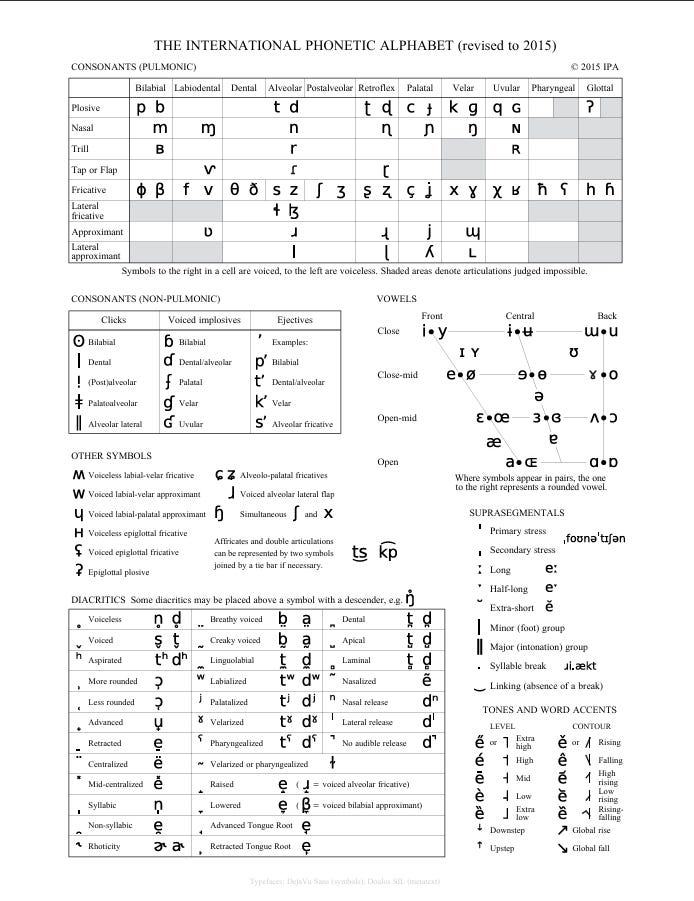
(source for all IPA chart images here)
The International Phonetic Alphabet, or IPA, is an alphabet where every character stands for exactly one sound. It’s time-consuming, but learning it makes learning accents, new words, and unfamiliar sounds in new languages much easier. Using the IPA isn’t strictly necessary, but using a specific symbol for each sound makes communicating sounds faster, and the IPA is the conventional alphabet for the purpose. IPA transcriptions are often written in square brackets. For instance, [hai hɔu æɹ ju].
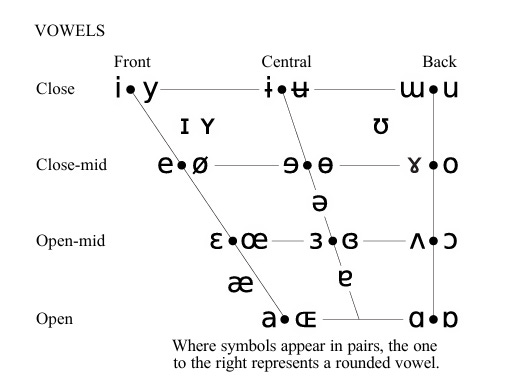
On the vowel chart, the vowels are placed where the tip of the tongue goes in the mouth to make them. For instance, [i] in the top left is the vowel in “feet”, and [o] on the right is the vowel in “snow”. In pairs of vowels, the left vowel is made with the lips unrounded and the right vowel is made with the lips rounded.
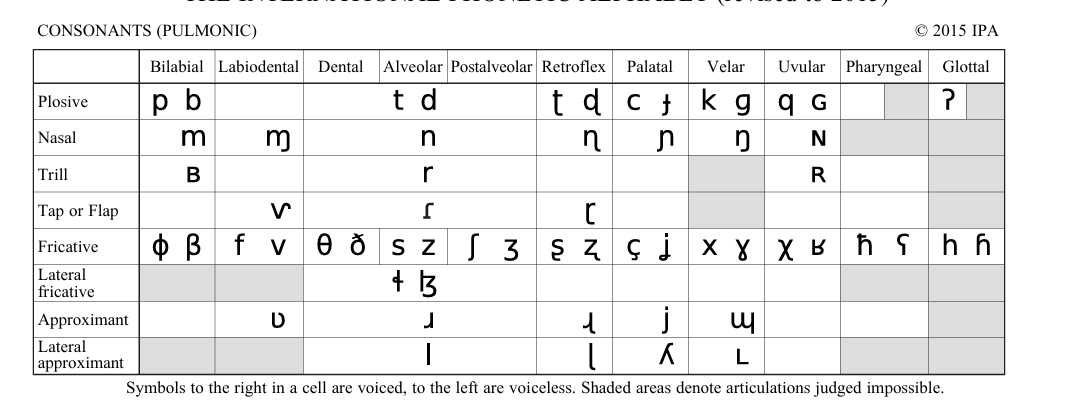
The chart of pulmonic consonants (consonants made with air from the lungs) is divided between places of articulation (columns) and means of articulation (rows).
Places of articulation
Bilabial: Made using the lips.
Labiodental: Made using the lips and the teeth.
Dental: Made by touching the tongue to the teeth.
Alveolar: Made at the ridge behind the teeth.
Postalveolar: Made just behind the alveolar ridge.
Retroflex: Made curling the tip of the tongue backwards toward the hard palate, where we make [j], the consonant we spell as “y”.
Palatal: Made with more of the tongue on the hard palate.
Velar: Made on the soft palate.
Uvular: Made by touching the tongue to the uvula, the bag at the back of the mouth.
Pharyngeal: Made at the pharyngeal wall, the space at the back of your mouth.
Glottal: Made with the glottis, the flap at the bottom of the pharyngeal wall.
Means of articulation
Plosive: The air is stored up behind the articulator (the part of the mouth making the sound) and then released in a burst, like in the “b” sound.
Nasal: The air is released through the nose.
Trill: The articulator repeatedly briefly releases air (think of the Spanish “r”).
Flap: The articulator very briefly blocks air (think of the Japanese “r” or the “t” in “butter” in an upper-class English accent).
Fricative: Air hisses out past the articulator.
Approximant: The articulator only ever stops a little of the air.
The fricative and the approximant have lateral forms where the air comes out around the sides of the articulator.
When consonants are in pairs, the one on the right is said with voice (if you put your hand at the bottom of your throat while you say it, you feel a buzz).
Vowels followed with a colon are held longer than normal (for instance, [a:] is longer than [a]. If you’re a musician, think of it as a half note versus a whole note.)
Sound Correspondences
While one has to figure out each accent’s sound correspondences independently, there are a few general rules to listen for.
Consonants
There are a few specific consonants whose various forms make the accent stand out.
R
First, a section on rhotic vs-non rhotic accents. This distinction deals with how the language handles the English-language “r” sound, or [ɹ]. Rhotic accents of English, such as most US accents, say [ɹ] whenever “r” is written. Non-rhotic accents, like many British accents, don’t say “r” if a consonant comes after. [ɹ] only ever comes between vowels, and when the two vowels are in two different syllables, the [ɹ] is generally pronounced as the start of the second syllable. [ɹ] only comes at the end of a word if the next word starts with a vowel, in which case the [ɹ] is pronounced at the start of the second word. Non-rhotic accents often insert [ɹ] where there is no “r” written, especially between words when the first ends with a vowel and the second begins with one.
Now, some specific forms of the R.
1. Tapped – pronounce the R as a tap. It can be on the ridge of one’s gums, retroflex on the hard palate, or on the soft palate.
2. Molar R – retract the tongue, put the sides of the tongue against your top molars, and pull the tip of the tongue back into the body.
3. Retroflex - the above retroflex R, but sustained instead of tapped.
4. Free R – Bend the tip of the tongue up toward, but not to, the ridge of the gums.
5. Weak R – Instead of using the tongue, touch the inside of the bottom lip to the top front teeth and make a W sound.
L
1. Dark L – touching the back of the tongue to the soft palate.
2. Light L – touching only the tip of the tongue,
3. W substitute – The back of the tongue lifts up, but instead of the tip moving, the lips round.
H
Some accents pronounce H at the start of words and some (Cockney accents, for instance) drop it.
NG
Different accents make the sound written “ng” hard or soft, and in the context of the sound “-ing”, accents often replace the sound with an “n” (“runnin’”, “dancin’”).
1. Hard NG – raise the back of the tongue to the soft palate and release with a K/G sound.
2. Soft NG – do the same, except release silently.
TH
TH has two forms – [θ], said without voice (“thin”) and [ð], said with voice (“the”).
[θ] may be left as is, turned into [θʰ] (the h means it’s plosive, meaning that you feel a burst of air if you hold your hand in front of your mouth while you say it), or replaced with [t] or [d].
[ð] may be left as is, turned into [ðʰ], or replaced with [d] or [v]. It will never become [v] at the beginning of a word.
Glottal Stop
The glottal stop, symbolized [ʔ], is the sound used for the “tt” in the word “bottle” in Cockney accents.
1. Some accents use it to replace sounds including [t] [f], [θ], and [ð].
2. Some accents move the mouth into position to make a [t], [p], or [k], and then make a glottal stop instead of the sound.
3. Some accents use it to replace the words “to” or “the” altogether.
Collisions
When several consonants appear together, often the human tongue wants to simplify. Consonants disappear, or some become more like others.
[ju]
While there are exceptions, the sound [j] often appears before [u] in one of four patterns:
1. Everywhere.
2. Everywhere except, in stressed syllables, after [l] and [s]. In unstressed syllables it still appears, and can appear after [ʃ].
3. Everywhere except after [l] and [s], with [tju], [dju] and [zju] becoming [t͡ʃu],[d͡ʒu] and [z͡ʒu].
4. Dropped after every alveolar consonant except [ɹ].
Vowels
Vowels are more fluid than consonants – a lot of the vowel differences that characterize accents involves small, precise changes that don’t change what the vowel is, but make it sound noticeably different from other forms of that vowel. Vowel differences mostly come down to how the tongue, the lips and the jaw are held. Try creating a neutral [ə] sound (the schwa, the sound in an unstressed “the”), and move towards the desired vowel and back towards the [ə], changing aspects of one’s tongue, lip and jaw positions, to find how to make the desired vowel. Other differences involve how long one holds a vowel and whether the vowel stays the same vowel the whole time one is saying it, or if one changes to a different vowel (this pattern is called a dipthong; think of the [ai] in the word “I”).
Consonants near a vowel can also change how it sounds. For instance, a vowel might sound different if an [ɹ] comes immediately after than if not, or if it is followed by an [n] or other nasal consonant. This is because the mouth is moving into shape to say the consonant before it is saying the noun.
Vowels often sound different when they’re unstressed. They often get replaced with an entirely different vowel, most notably the schwa.
3 – Practice
Now that you know the accent’s structure and you have materials for studying, you can start practicing. Read signs and books out loud. Narrate what you’re doing – getting a snack, petting the dog – in the accent. Speak in it to your friends if they’ll let you. If you’re learning a role, read the lines in the script. Find a phrase that gets you into the accent, so you can say that phrase under your breath when you need to start speaking in the accent suddenly. The more practice you give your tongue (and whole face), the faster you’ll learn.
Appendices
Appendix 1 - An Interview With Amy Walker
Transcript:
(note that this transcript is cleaned up - some things like repetition, false starts and interjections are removed. Some words and accents may have been missed or misidentified.)
INTERVIEWER: So, hi, thank you for making time to do an interview today. I appreciate it. So, first off, to start, how did you get into acting?
WALKER: Oh gosh, how did I get into acting. I mean, I guess I’ve just been acting ever since I was quite little. Both my parents do music, and maybe 2nd grade I was in my first play or 1st grade, but I remember paying a lot of attention to Mary Poppins and different things, and then when I was 8 I was in a mime that was really cool because it was just using your body to tell the story, and I thought that was fascinating.
INTERVIEWER: I see, I see. Over your career, what has been your favorite role?
WALKER: My favorite role? Ummm, ooh, I loved playing, well, I loved, gosh there’s so many [laughs], I loved playing Inez Milholland who is a martyr to the suffrage movement and to equal rights for all in a short film I made called Into Light, but also when I was 16 I had the honor of playing Helllen Keller in a local production of The Miracle Worker, and that, I spent a year really working on that, to do it properly and – yeah, she’s just such a phenomenal human. So I like playing real people and having that - those tight parameters of, you know, needing to recreate somebody who is somebody I look up to.
INTERVIEWER: Hmm. So how did you get started doing accents?
WALKER: Uh, I think it’s just something that I always paid attention to. I remember specifically [upper-class English accent] Mary Poppins, you know, watching Mary Poppins, [normal accent] and seeing how Mary would say certain things, you know, she would say [upper-class English accent] “St. Paul’s” you know, like “St. Paul’s Cathedral”, [normal accent] and then I- working out in my head when I was 5, 6, what that even means, “oh, it’s Saint Paul’s”, and then listening to [lower-class English accent] “Gah! You don’t think the lion could’ve gotten him do you, you know [unclear] banging around the cage,” [normal accent] you know just seeing Ellen is different, and then Cook is different, and then Bert is on his own, bless him, but his own little world, so it was just really interesting to me trying to understand what people are saying and why they’re saying them in different ways, and then I - it wasn’t until later or I guess I just kind of started putting them in little boxes in case I ever played a role from there, you know, and then definitely watching Meryl Streep growing up, and Sophie’s Choice and how she was learning Polish in order to do the accent from that lens, and just really leaning into - there were a couple of, [Australian accent] I watched a Baz Luhrmann film, I love his work, Strictly Ballroom, if you’ve seen it and - yeah! And just going like if I ever have to play someone, if I ever get to play someone from Australia, ‘stralia, that you know, like I want to do it properly, so it’s part of – for me it’s half of your job as an actor, is to be able to sound authentically like the person, so that was always really important to me.
INTERVIEWER: Yeah. So, what’s your strategy, how do you get started, how do you get started when you’re learning a new accent?
WALKER: [normal voice] Me personally? Um, hm, that’s great, I’m really an in- like, from the inside out kind of a person, so if it’s a script that I didn’t write, I’ll get as many cues as possible from that character and how it’s written, and what people say about that character, one that comes to mind is playing Jo March in Little Women, she’s so clearly – leaps off the page for me, and her word choice tells a lot about how she thinks, and so, like for that one particularly I was looking at what were some handwriting, you know what would the kind of pen be that she would use in that era, and I got - actually I still use a writing desk that’s from that Civil War era, the kind that her father would have used, you know like a travelling writer’s desk that has that, it’s made of wood and it has a tilt so that when you’re writing with pen and ink you can get the proper flow with a dip pen, and you know I would have ink all over my hands and be writing in that way and so just getting into her voice through Meg – I still have artifacts of her handwriting in my personal handwriting because I loved the Ws for example and so I often do writing first in character, like living into different parts of the character than are on the script, for example, maybe things that weren’t referenced in the script, and then if it’s somebody who I need references from that time period, or if it’s a real person that I need references there, I’ll be listening and shaping how I hold my body and how I hold my mouth to, [Southern accent] you know if they’re from the South, there’s just so many places, but it’s like how, where they hold tension in their mouth, where they hold tension in their body, are they wearing a corset, [normal accent] you know, it shapes, it begins to really shape that accent for me. Or the voice, I mean.
INTERVIEWER: So what is, how do you practice from day to day, what kind of resources do you use, like what resources do you use for immersion in the accent and getting exposed to it so you can know what it sounds like.
WALKER: Cool. Great question; I really mostly go to YouTube. It can be more challenging to find references that are you know 1800s, and so I’ll just lean into a Transatlantic, or it depends on where they are from, if they’re British or something, but I go to YouTube first because personally I like to find a reference of a person who’s as similar as possible to the character. I want all the analog information; I wanna find when they are not thinking about how they sound, because things like grammar that they’ll put in, the way that they’ll hold themself, the way that they’ll maybe be thinking about how they’re coming across or not thinking about it. All that is really key information for me, so when I coach I take people through in a linear way because a lot of people need to learn first what are particular vowels what are particular consonants, but for me I can pay a lot of attention to a lot of different things, and so like for example when I was the voice of Audrey Hepburn in a documentary, I’m looking at very specifically films but particularly interviews from that specific era within a couple of years, within about three years, because I’m feeling into her tamber, how she holds herself, you know she says [Audrey Hepburn voice] gaunt like the particular shape of those consonants that nobody else does [normal voice] you know but then I’ll watch how she is on film but then especially interviews are going to be much more, for like for what I needed, I wasn’t recreating her in a movie, I was recreating her in real life, then I need to get as much as possible what she sounds like in real life, you know not when she’s acting. So for me I need to find, the reference is key, and then especially if it’s a real person I will grab that audio and put it into my recording software and I will, this is the tedious part, I just take small samples and go and copy it and go paste, and leave a space, and then paste, leave a space, paste, leave a space, and I’ll listen and repeat and listen and repeat and listen and say it at the same time and see am I matching the pitch, am I matching the tamber, am I matching the pace? Am I too fast, am I too slow? Did she go hmmm and I went hmm, you know, and so I need to get all of those intervals just right because the difference between an interval being here and being here could be [Irish accent] Ireland vs the UK or something, [normal accent] so it’s just a lot to pay attention to, and so I pay attention to as much as possible and then I go back and I listen and then I find those adjustments and I do it again and I do it again and I do it again until I can nail it the way that I want it. And that’s for if it’s a voice match, and I’ve done voice matches for Rebel Wilson who’s an Australian comedian and actress, and for Kerry Condon, who’s Irish, for Audrey Hepburn, and if it’s not a person specifically but just an accent then I will find multiple resources, usually one if possible that I can emulate the most, but then I’ll cross reference and then mix it with what I bring to that character as well.
INTERVIEWER: I see. Can you explain what a voice match is please?
WALKER: Yeah, sorry, so in the case of Audrey Hepburn she’s no longer living, so they needed somebody for this movie to be able to recreate her voice, as if it was her saying something that she never recorded. In the case of Kerry Condon this was for Disney in Paris, there was a ride, and they wanted to have the voice of Friday from Iron Man and she did that voice but they didn’t want to pay her because she’s a lot more expensive. So, they’ll get somebody who can sound as close to exactly like them as possible. Or in the case of Rebel Wilson, she swears a lot when she’s improvising, and so when they wanted to do the TV version, they need somebody to dub alternate versions of those lines, and have it be seamless so that it just sounds like her and they can cut around it. So a match is when they pay somebody else to sound exactly like an actor.
INTERVIEWER: I see. So, what proportion of the accents that you learned have you learned in childhood or young adulthood versus full adulthood?
WALKER: That’s an interesting question. I would say 95% I’ve learned since being a young person, but like mostly all I had growing up on a tiny island on the Northwest was like Disney so [upper-class English accent] you know certainly English accents, there are those, and I got a good foundation through there, but [Australian accent] couldn’t get much of Australia like this, I think most of it I’ve done since, [accent trails off] during and since university. [possible New Zealand accent] New Zealand, certainly, I lived in Wellington for a year and a half, and I love it, but yeah I think [fully normal accent] mostly they’ve been through work, and through you know opportunities coming in. Well, let’s see I did a video called 21 Accents in 2008, so that was right after college, so for that I guess I had but nah, so this was before YouTube was Google, this was before we knew millions of people would watch a video, it seems impossible to think of a time like that, but if I had known there would be people from all of these countries listening I think I would’ve freaked out a lot more, but I just did what I picked up from osmosis mostly, but then I knew that [Scottish accent] going back and forth like from Scottish to [Irish accent?] Irish accents for example or [slight accent] Australian to New Zealand, I knew that going back and forth between them was hard [normal accent] so I worked specifically to put those transitions in knowing that it’s hard. So for those kind of things I actually I worked those before that video, but then I got a lot better at all the accents after that video because the pressure was on.
INTERVIEWER: Okay, so what would you say is the hardest part of learning an accent, and what would you say is the most fun part.
WALKER: Hmm, the hardest part of learning an accent is finding a – for me is finding a sample that’s good and clear and has all the standard markers, so sometimes with an accent you need to hear specific sounds or else it can be hard to place that accent, and so you need to be able to identify what those markers are. For example, going back to that 21 Accents video, the reason why I added in, I can’t even remember how it had anything – it didn’t have anything to do with anything but I added in like five, six, seven, something like that because I knew that I had to put those vowels in for the New Zealand accent or you wouldn’t be able to tell the difference. So, finding, like Welsh was really hard for me to find I was in a production of Under Milk Wood and at YouTube at that time there was like one woman who is Welsh, [Welsh accent] and she’s a poet, and she did a poem called Handkerchief Kiss [normal accent] and so I had to base everything on her because I had nothing else, because a lot of Welsh people end up doing kind of an English accent because it’s been very much maligned, that accent, strangely, even though it’s gorgeous and elvish, but yeah so for her the way that she would say [Welsh accent] what a tame lot we were, [normal voice] what was it, [Welsh accent[ our secretive yesterday’s kisses, [normal voice] something about like Welsh accent] a poem translated is like kissing through a hankey said the bard [normal voice] getting those little bits and then because I only had one video I had to try and extrapolate out into a whole script, little bits from her so that for me is the hardest thing. And then the most fun, it’s probably making those connections. Well, let’s see. Making those connections and then once I get to the point where I can, I feel like I can just dip into the stream of it, and things are coming out in that accent even though I’ve never heard them or said maybe specifically before, that to me is so fun.
INTERVIEWER: Umm yeah. [WALKER: [unintelligible] it really clicks.] So in what sense, or in what ways do you use accents in your non-acting life, in day-to-day life.
WALKER: [upper-class English accent] Oh, that’s a great question, I um, a lot. I use them a lot. I’m weird! So for me you know sort of a standard English accent really feels normal to me a lot of the time, um, [country accent] but, like, there’s just certain things [Irish accent] that feel like they just make more sense to me in different accents, and, emm I dunno who I am. [different country accent] I don’t do it all the time clearly, but like every day, you know, there’ll be something and it’ll just make sense and so I’ll just kinda lean in.
INTERVIEWER: Yeah so, how do you retain accents when not using them for a role, do you for accents that you don’t naturally use daily or regularly, do you have to do anything special to prevent your skills from atrophying.
WALKER: [normal voice] Mmm, that’s a great question. Yeah, they do, they need to stay pretty present or they’ll get funky. So there are some that I you know use less and that I would not tend to launch into unless I’m gonna risk it, but it can be really helpful to have an anchor phrase like, like [Irish accent] “cat” [normal accent] for me in Irish just the word [Irish accent] “C-A-T”, [normal accent] or [Yorkshire accent] “chip butty” for Yorkshire, like “chip butty”, I love that phrase, I’ve never had a chip butty, I can’t do gluten, but “chip butty”, [normal accent] it’s a great one. Yeah. But then if it’s something that I haven’t had, that I haven’t lived in for a long time, it’s then I only have a small portion available to me and if I was gonna properly play a role, I would do more research to build it back up. So for things that, well, and this is, when the script is provided and when the script is well-written, in that vernacular, right, so one of the I guess back to your question about what’s the hardest, it’s especially for English language accents, it’s that we, it’s all English but we use words differently, and that just takes time to learn how people structure their vocabulary and their grammar differently, and it’s one of those things where if you don’t know I might say something like in [Australian accent] Australia I might say is there a drinking fountain, you know, and that would be like I would be saying it in an Aussie accent, a proper Aussie accent, but they don’t call them drinking fountains, they call them bubbler. It’s a bubbler. So, unless you know, is there a bubbler around, [normal accent] then you wouldn’t know to say that phrase properly.
INTERVIEWER: Hmm, I see. So, about how many takes did it take you to do the 21 Accents video.
WALKER: Ah, great question. I didn’t even count. Dozens. Dozens. And I did the first day, I probably took a few hours to get into it because at that time switching was really hard and then I did several takes and then I had lunch and then I did takes all afternoon until I couldn’t do it anymore and I thought I had it and then I watched it the next day and I was like, no, I can do better and so I did more, so I really don’t know. But the one, the video I actually did the most takes on is one little thing called “Getting Ready for a Date”, and people literally thought I was just getting ready for a date, and it was actually like I’m singing between two different octaves, I’m singing these parts of a violin and a viola, but I’m timing it to all of these things of getting ready for a date, and people just go “I hope your date was fun”, and it was actually like I spent weeks on that video. So it takes a long time to make it look easy.
INTERVIEWER: Yeah. So you did some videos of advice that you would give to anyone trying to learn an accent. Since you did those videos is there any more advice or what advice would you like to add to the advice that you gave there?
WALKER: Yeah, great question. I don’t remember what I said in those videos, but I think I was breaking it down between vowels, consonants, was I, or no, pronu- vowels and consonants, melody, rhythm, stress and the vibe probably?
INTERVIEWER: Grammar- grammar and word meaning.
WALKER: Grammar and word meaning and the vibe, yeah, so that all still applies, I don’t remember whether I said that the sample is the most important, but it really is you know, I think one of the challenges for people – like I often use the accent tag videos to identify an accent that I – or to identify a source for an accent that’s natural to a person, but what I use is I don’t use the beginning of that where they’re answering the questions – do you know the accent tag videos?
INTERVIEWER: No, I don’t
WALKER: Oh, this is a great thing on YouTube. There have been two different ones and it’s just called the Accent Tag and it’ll be ones where people who are from all these different parts of the country and world will answer certain questions, it’s supposed to be just in their natural mother accent and so you get a sense of you know there’s something standardized about it but then you get these different answers but what I’ve noticed is a lot of times people are self-conscious about their accent and so they might tend to kind of minimize it in the beginning, but what I look for is the end of the video or the beginning of the video before they’ve started, but usually the end, whenever they’ve started to really relax and not think about how they sound, that’s the good stuff for me. [Right, yes] So – what’s that?
INTERVIEWER: No I was just saying Yeah. Yeah.
WALKER: So those are what I will take and use as my samples and in that way that I mentioned to you of get recording software, it can even be GarageBand, it can be Audacity, it can be free, but to have two tracks and to have one with your sample where you’re just taking 3-5 words at a time and then space and then the same sample and you do that 5 or 6 times the same thing, and then record yourself in between and listen back, because people when you’re just saying it it’s hard to know what you’re hitting and what you’re missing, and these are microadjustments that make all the difference, where literally you’ll sound like you’re from a different country if the interval is off, and by interval I mean the space between two different notes. So if it’s “yes” versus [lower] “yes”, that’s like the US and Ireland, totally different countries, or “yes”, England [lower] “yes”, [Irish accent] Ireland, you know [normal accent] so, or people might go um “Yes”, or they put weird curlicue things in for English, and unless you listen to them right side by side it can be hard to know whether you’re exact or you’re not. And then I would say, when you think you have it go and talk to strangers in that accent who also have that accent and that will be your biggest test of whether you have it or not, because if you have it they won’t hear an accent, and if you don’t, they will.
INTERVIEWER: I see. Well, I think that’s enough, I think that’s it, thank you for – thank you for your time, I’m glad to have been able to talk to you today.
WALKER: It’s my pleasure Alfie. Great questions.
INTERVIEWER: Yeah. Yeah. Well, bye.
WALKER: Take care. Bye bye.
INTERVIEWER: Yeah. Take care. Bye.
Appendix 2 - A Guide to the Russian Accent
(This section takes from Foreign Dialects.)
An example set of sound correspondences:
General rules
1) Speak slowly and with longer vowels.
2) Put heavy emphasis on emphasized syllables and very little on all others.
3) Put a [j] between certain consonants and certain vowels:
[l] when followed by [i]/[I]/[ɛ].
[n] when followed by [i]/[I]/[ɛ]/[a].
[d]/[t]/[θ]/[ð] when followed by [I] or [i].
Vowels
[ei] = [ɛ].
[ə] = [ɒ].
[ɒ] should be shortened. If it is already short, it becomes [ɔ].
[a] is [ɒ]. If short it can become [ɛ].
One purses one’s lips while saying [ɔ].
[i] is [I].
[ɛ] is [a].
[ɒi] has emphasis on the [i].
[I] is [i].
[ou] is [ɒ].
[u] is [ʊ].
[ʊ] is [u]
[ju] is [jʊ].
[ʌ] is [ɔ].
[əːɹ] is generally [ɔr], or can be [ɛr] under the right conditions.
[ɒu] is [ɒ:].
[ɔi] is [ɔI].
Consonants
In general, [b] at the end of words (final [b]) is [p] unless the next words starts with a voiced consonant (“followed by voiced”).
[d] is [dð] or if at the end of the word [tð] unless before a voiced consonant. It is dropped at ends of words after consonants.
Final [f] is [v] before voiced.
Final g is k before voiced.
[h] is [x].
[dʒ] is [tʃ].
Final [k] is [g] before voiced.
[l] is always a dark [l].
Final [p] is [b] before voiced.
[kw] is [kvw], and [w] in general is often [vw].
[ɹ] is a trilled [r].
[s] is really sibilant (or hissy). Final [s] is [z] before voiced.
[t] is [ð] and dropped at the end of words after a consonant. Final [tθ] is [dθ] before voiced.
Final [v] is [f] before unvoiced.
Final [z] is [s] before unvoiced.
[ð] is [dð].
[θ] is [tð].
[ʒ] is [ʃ].
[nk] is [nk].
So for instance, and given Russian grammatical differences:
[Ai wIl si hIm]/[Ai vwil [dark l] sI xim].
[Ai æm frʊm ði parti]/[Ai frum pɛrðI].
Appendix 3 - Sources
“3.3 Describing Consonants: Place and Phonation.” ENG 200: Introduction to Linguistics, by Catherine Anderson et al., eCampusOntario, 2022, Pressbooks Directory.
“3.6 The International Phonetic Alphabet.” ENG 200: Introduction to Linguistics, by Catherine Anderson et al., eCampusOntario, 2022, Pressbooks Directory.
Amy Walker. 21 Accents. 2008. YouTube,
.
Antastesia. The Accent Tag with a French Accent :). 2013. YouTube,
.
Ar and Char. Accent Tag | Jamaica, Trinidad, Barbados, United States |. 2018. YouTube,
.
Herman, Lewis, and Marguerite Shalett Lewis. Foreign Dialects. Theatre Arts Books.
“Internationalphoneticalphabet.” International Phonetic Alphabet, 2015, www.internationalphoneticalphabet.org/wp-content/uploads/2016/08/IPA-Chart-Deja-Font-2015.pdf.
“Lexical Sets from J.C. Wells’ Accents of English: Introduction Chapter 2.” York University | Toronto, Canada, www.yorku.ca/earmstro/courses/phonetics/lexical_sets.pdf. Accessed 29 May 2026.
Michael Newell. Accent Tag Massachusetts. 2012. YouTube,
.
Rowles, Jan Haydn, and Edda Sharpe. How to Do Accents. 2nd ed., Oberon Books, 2009.